The Afternoon Depression Zone
Lessons in ChemistryThe Afternoon Depression Zone is Walter Pine’s term for the stretch of afternoon when, in his account, people’s productivity falters and television offers respite rather than demanding attention. The idea explains both the shape of afternoon programming and why Elizabeth Zott’s show is scheduled for 4:30: she is expected to re-energize viewers just as they emerge from the slump. Its rationale is double-edged. The schedule recognizes the exhaustion of housework, yet imagines television’s task as helping homemakers resume it.
Definition and Daily Rhythm
Walter introduces the concept while discussing circadian rhythms. He says humans are biologically programmed to sleep twice a day: an afternoon siesta followed by eight hours of sleep at night. Most Americans, he claims, skip the siesta because work demands it, even though productivity naturally declines in the afternoon. He sets the zone’s boundaries with comic precision, from 1:31 to 4:44 p.m., and describes it as a period in which productive life virtually stops.
The unusually exact hours make the expression sound like a measurable broadcast category, while Walter’s sweeping description makes it a condition shared across social roles. Homemakers, fourth graders, bricklayers, and businessmen are all subject to the decline. The examples, however, do not imply that everyone can respond to it in the same way. A student may postpone homework; a businessman may pretend to listen. Those options establish procrastination as a form of relief available to some people, not all.
Housework and Unequal Pressure
Walter singles out the homemaker as especially vulnerable because her responsibilities continue through the afternoon. Children must be put down for naps, the floor mopped before spilled milk causes someone to slip, and a trip to the store made so that there will be food. Even the expression run to the store catches his attention: the verb suggests a pace of activity that turns an ordinary errand into part of a larger demand for constant motion.
The pressure culminates in dinner, which the homemaker must still make despite being, as Walter puts it, over her head. He presents the consequences as potentially serious: she may suffer a heart attack or stroke, or at least end the day in a foul mood. His account therefore gives the term more weight than a joke about sleepy afternoons. The zone names a conflict between a bodily need for rest and a domestic schedule that offers little room to stop.
Elizabeth responds by describing the situation as neurogenic deprivation: the brain is not getting the rest it needs, executive function drops, and corticosterone levels rise. Her concise scientific explanation meets Walter’s domestic account on its own terms, translating afternoon exhaustion into bodily and cognitive effects. She then asks what any of this has to do with television, making the jump from a description of fatigue to a theory of programming explicit.
Television as Rest and Childcare
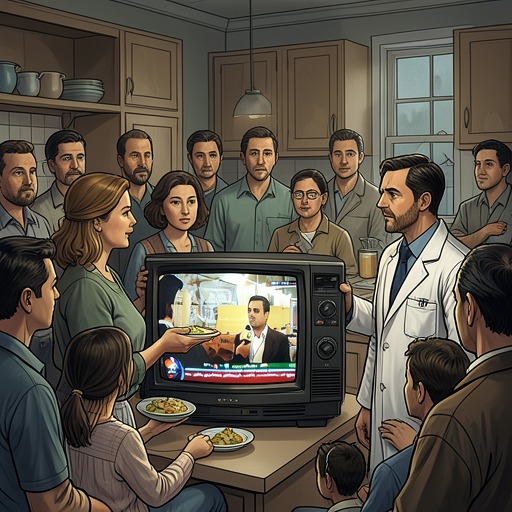
Walter answers that afternoon television is designed to let the brain rest. He points to the lineup from 1:30 to 5:00 p.m.—children’s shows, soap operas, and game shows—and argues that these programs demand little actual brain activity. In his explanation, the schedule is not accidental: television executives recognize that viewers are less alert during these hours. The zone thus functions as a programming principle, connecting an asserted human rhythm to the kinds of shows placed in a particular part of the day.
He describes the lineup as a public service, especially for the overworked housewife. Children’s programs, he says, electronically babysit children and give their mother time to recuperate before her next act. That next act is making dinner. The rest offered by television is therefore both genuine relief within Walter’s model and preparation for a return to work: the homemaker is meant to recover enough to continue meeting the demands that produced her exhaustion.
Elizabeth’s 4:30 Responsibility
Elizabeth’s program is assigned the 4:30 slot, exactly when Walter says viewers will be emerging from the zone. He characterizes the timing as difficult because housewives feel the greatest pressure then: dinner must be made, the table set, and the children located, all within a short window, while the audience remains groggy and depressed. The show is not merely to fill an afternoon schedule; it is expected to change the audience’s energy at a consequential point in its daily routine.
Walter’s instruction that Elizabeth entertain is consequently presented as sincere rather than as a demand to abandon her interest in food that matters. Her food-centered mission, he insists, requires making the process look at least a little fun. The contrast with a hypothetical 2:30 placement clarifies his reasoning: he would put a dulling program earlier, not Elizabeth and her hot pads. The distinction assigns her a task beyond providing recipes or information. She must make viewers sit up, listen, and feel able to move into the next part of the day.
Walter grounds his confidence in a previous afternoon encounter: Elizabeth had stormed into his office and made him sit up and listen despite his own familiarity with afternoon programming and his claimed place inside the zone. He calls that response nearly statistically impossible, then treats it as evidence that she can do the same for other people. His account turns an earlier moment of Elizabeth’s forcefulness into a reason for the time slot and its expectations. After hearing him out, she admits that she had not considered the assignment in those terms; Walter calls the explanation TV science, knowledge that hardly anyone possesses.
The expression consequently holds two views of afternoon television together. It identifies a need for rest and acknowledges that domestic labor can demand continued effort when the body is flagging. At the same time, its solution is a program that revives the homemaker for the remaining work rather than removing that work. Elizabeth’s show occupies the threshold between enforced pause and renewed activity, with the audience’s attention treated as something television can restore.